Reflections on Slow Childhood

I’ve been really touched this past week by the gentleness of God and the child-ness Barefoot Girl. At God’s quiet persistence, I’ve relaxed my hold on our daily schedule and over time created gentle rhythms: morning read aloud (that we’ve done since babyhood), followed by a science experiment, then a hands-on activity like making bread or harvesting herbs, finished by lunch and clean up together and sprinkled throughout with what Charlotte Mason would call “spreading the feast” and unschoolers would call “strewing.” Afternoons are given to music practice, her own projects that she has in mind for the day which usually involve an audiobook and creating something, and daily chores.

It’s been good.

This past week, though, has been confirmation. I’ve wasted so much time regretting my distracted state during early motherhood and feeling like I missed cherishing her childhood for so many years, and with the speed of today’s childhood I have operated under the mindset that she’s already transitioning into the “pushback” stage of adolescence; however, having the quietness and the space within my own spirit to listen to God and really see her has shown me otherwise. In following our gentle rhythms this week I was touched by the lingering child-joy that she still radiates when given the chance, such asthe bubble science experiment that led to a bubble blowing session in the spring sunshine and her delight in just playing and experiencing life with me. Another morning she felt led to put on a pretty dress (that ended up being one that my mom sewed for me when I was her age – and she enjoys it!) and dance to the Lord with some praise music, and I realized something.

I was blessed by that. It’s not often that I use that word, but there it is. God used it to remind me to be less of a Martha (Luke 10:38-42) and give time in the day to be free to praise or live as the spirit moves us; not only that, but I realized that in the beautiful God-order of things, families are meant to be reciprocally ministering to each other. I think I place the weight of “blessing” my family on my own shoulders, and forget to look at where they’re blessing me too. I know that I tend to operate in the rigidity of my own to-do list and schedule, and I’m learning flexibility.

“And do not be conformed to this world, but be transformed by the renewing of your mind, that you may prove what is that good and acceptable and perfect will of God.”

Romans 12:2

My years of homeschooling a highly sensitive child (and living with an HSP husband!) has given me a different perspective on a lot of things, but one of them is definitely education. For the first several years I tried to “do school at home” and was frustrated and discouraged when that didn’t work. It wasn’t until embarrassingly recently that the Lord led me to understand that Romans 12:2 relates to everything in a Christian’s life, including how we educate. The “school at home” method still conforms to a fallible human’s idea of what a properly educated person looks like, but that’s not what I believe to be true.

What is true is that each person, each child, is made uniquely in the image of her Creator, and they’re each different from each other, so why do we try to “educate” them all the same? Some, mine included, are more sensitive to the world around them and feel deeply all the emotions of the people they’re around, are extremely sensitive to others’ approval or criticism, are hyper aware of the discomfort of the wind or the heat or the cold or their clothes, are fully alive to all the joys and sorrows (from the loss of a wild rodent to a family member – it’s all felt deeply), and yes, they actually do have a lower pain tolerance because they physically feel things more.

Some people might tell kids like these that they need to toughen up, but I’m not one of them (anymore), and here’s why:

God made them that way.

If God made them to be feel life that deeply, who are we to tell them they should experience life in a way different that the Creator of their souls intended for them to experience it? Society needs people that have an enhanced sensitivity to everything around them and experience the world in a way that many of us never will, with all senses wide open and a finger on the pulse of the world around them — aware of all the scents, sounds, colors, and feelings that they come in contact with. In truth, perhaps I also wonder what it’s like to be so fully alive to the world around me. I have reached the point that I do feel numbed and cynical to life, and I need my highly sensitive family members to keep me in touch.

This sensitivity means that they also need more “empty space” in their lives to download all of this stimulation, and a lack of this space results in severe anxiety and ultimately depression — just ask Mr. Buckeye.

And so I’ve come to realize that highly sensitive kids really do need a slower childhood. They need time in the day to dance, to blow bubbles, to play . . . and our conventional culture pushes them to be too busy, too stimulated All. The. Time. so that their nervous systems never have a chance to catch up and unwind. In truth, the busyness of schools and constant activities robs them of their childhood and creates a generation of kids with severe anxiety (don’t think so? a simple google search talks about the epically high anxiety rates among today’s youth).

I believe I can say this with Biblical truth backing me: To God, educating a child is educating her soul, NOT keeping up with distant stranger’s arbitrary and ever-changing standards. It’s dancing to His beat in her heart, nurturing her soul by baking bread with Mom or picking flowers together, and honoring the beautiful sensitive spirit He created her with by not overwhelming her with someone else’s standards. We celebrate our own growth – even the adults – and don’t stress to keep up with anyone else; I’ve learned that God’s timing and plans are not my own, and it’s better to go in tune with Him.

My experience has been that we are closest to God when we’re living within the realm and the gifts that He gave us — that we experience Him most when we’re dancing or writing or woodworking — and honoring Him as our Creator. The way we educate is part of that beauty of life.

Violet Spring

I’ve really been loving getting back to our Herb Fairies studies . . . . it’s so grounding to be out harvesting beautiful little plants that take forever to pick while the spring birds and sun are filling your senses. Perhaps the world would be in better mental health if we all practiced this a little bit.

Violets are in full bloom, and today we harvested about 6 cups of “flowers” (actually, the plant doesn’t put out the true flowers until fall). We have a half gallon of infusion going to make jelly tomorrow, violet honey, and violet ice cubes for Barefoot Girl’s delight.

Last night our neighbor girl was over and helped Barefoot Girl harvest some violet flowers for dinner; it was her first experience learning that you can eat a common wildflower, and the look on her face was priceless. It’s the small things that make a difference — she’s a girl that already loves gardening and at eight years old talks to me about it almost every time she’s over, so who knows where she might take that knowledge?

Making Bread Starter from a Potato

I don’t actually have any experience baking bread, other than some darn good biscuits Barefoot Girl and I do once in a while . . . but since we’ve all worked for an artisan bakery and been spoiled by an amazing variety of artisan breads for 8 years, I think it’s about time I start baking bread to prepare for the time when Mr. Buckeye doesn’t bring home the bread anymore (because we’ll never be able to go back to store-bought again!).

I love sourdough and I’ll make it eventually, but I came across this interesting post from Ashley at Practical Self Reliance … and again, homeschool=learning project. Bread from a potato? Science experiment, check. It doesn’t look like much but it’s so interesting to me how the things we actually need (food) are all around us. I consider this to be learning experience for Barefoot Girl, but I’m learning right beside her.

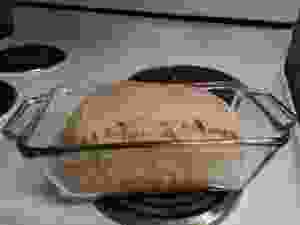
We seem to be fermenting all kinds of different thing lately, from potatoes to chicken feed. We’ve got the bubbles down. We’ll update this project in a couple of days when the starter is ready to use. But, since we couldn’t wait that long for some homemade bread, we gave it a shot with some quick yeast I had in the cupboard for a science experiment. I don’t think it’s too bad for our first try!

It’s a Dandy Time of Year

I first started becoming interested in herbs a couple years ago when I purchased the HerbFairies course for Barefoot Girl and I to do together. Even though it’s made for kids, it’s so engaging that it drew me in! What started as a slow interest is becoming a deep fascination and serious appreciation.

One of the first ways we started using herbs years ago was at just this time of year with foraged greens and flowers for salads . . . so although I’ve “dabbled” in dandelions and violets and chickweed, this year I’m really taking a serious look at what’s behind these plants.

Health

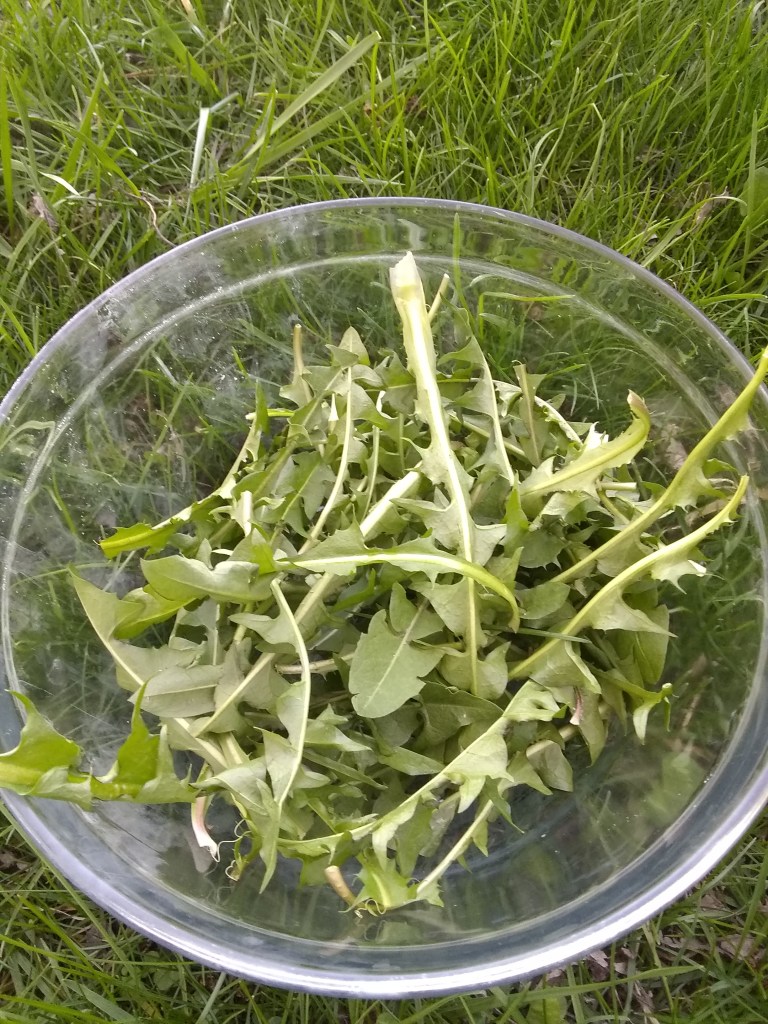
Cultures all over the world have used and admired dandelion’s use as a spring tonic to “start up” the digestive system after a winter of heavier meals; the bitterness of the leaves (which we’re actually enjoying — even Barefoot Girl is eating without complaint!) helps with digestion and constipation and are even used to balance out high blood pressure.

The leaves are rich in minerals such as potassium and calcium and vitamins A and C, and the whole plant is an excellent source of inulin 9

the white stuff) (the “pre” to the “pro” biotics — prebiotics feed the healthy bacteria that we need in our guts). Since poor gut health and low levels of healthy bacteria are linked to depression (and we’re dealing with that in our house), I am intentionally trying to add more of these types of food to our meals.

Early spring is such a potent time for foraging dandelion and other greens because the leaves are storing all the vitamins and minerals that will go into the plant’s flower later in the season. In fact, an herbal saying that’s helpful to remember the flow of the nutrients in the plant is “spring up, fall down” (nutrients are rising in the spring before falling back down to the roots for winter storage).

Foraging

False Dandelion – note the forked stem

Surprisingly, it is actually possible to make a mistake in harvesting dandelion. In my research this spring I learned that there’s a lookalike called Spotted Cat’s Ear or False Dandelion (Hypochaeris radicata). Although it’s not poisonous (dandelion is such a beginner’s choice for foraging that there wouldn’t be a dangerous lookalike), it’s interesting to learn how to look a little closer to make sure we have the right plant.

True dandelion leaves lack hairs, while the lookalikes have little hairs on the back and along the major leaf vein. They also have a single flower on a single stem — unlike the lookalikes that have numerous flowers per stem.

How to Eat

For now, we’re mostly eating them fresh on whatever fruits or vegetables we’re having, although Mr. Buckeye’s favorite way so far is sauteed in olive oil with garlic salt. I’ve wilted them on top of meat and gravy sandwiches, which is a delicious way to get just a hint of flavor without an overpowering taste. Soon, I’m going to start making some vinegars with the leaves and root to use as salad dressings. We’ll see what comes after that!

Pickled Eggs!

So. Many. Eggs. Eggs in the fridge, eggs on the counter waiting to be put in the fridge, eggs hardboiled in a bowl waiting to be processed, eggs in my dreams …

One nice thing about the Corvid-19 situation though is that it’s allowed us to meet a couple of our neighbors that have stopped for eggs since the stores have been out. I find that knowing my neighbors has a lot to do with my happiness, so I’m glad that we are raising a food that can help facilitate those connections.

But still. All the eggs.

Actually, it’s refining my philosophy of food self-reliance. I have been realizing that it’s really not necessary to feed our hens a commercial layer food for maximum egg production since we’re more concerned about the sustainability of the flock…but that’s a post for another day (maybe tomorrow).

I’m rather ashamed to admit that it ten-plus years of chicken keeping, I’ve never made pickled eggs. Perhaps because this is the largest flock we’ve ever had so this is the first time I’ve been faced with such a (blessed) surplus? For whatever, reason, I’ve had to scramble to not let them all go to waste. I needed a method that would use a lot of them and preserve them for quite a while . . . therefore, pickled eggs.

I first tried the recipe from one of my favorite kitchen books, Pickled Pantry, and it was DELICIOUS. I had not idea how much I would *love* pickled eggs. The family likes them too, so that’s a major win!

I just got done making my second batch with Barefoot Girl’s assistance, and I modified this one to included sliced red onions and fresh dill sprigs instead of the dried edill weed. This is a cold-pack refrigerator pickle recipe so we have to wait a week to try them. Can’t wait!

::::Update:::: They’re even better! This is the way to go from now on! The pickled onions and garlic are delicious in and of themselves, but they add so much flavor to the entire batch that I won’t want to ever do a batch without them.

*Note: the above picture is from a jar that we’ve been eating out of for several days, so the cloudiness is an indicator of disturbance and my poor photography skills.

My Very Classy DIY Garden Bed Chicken Protector

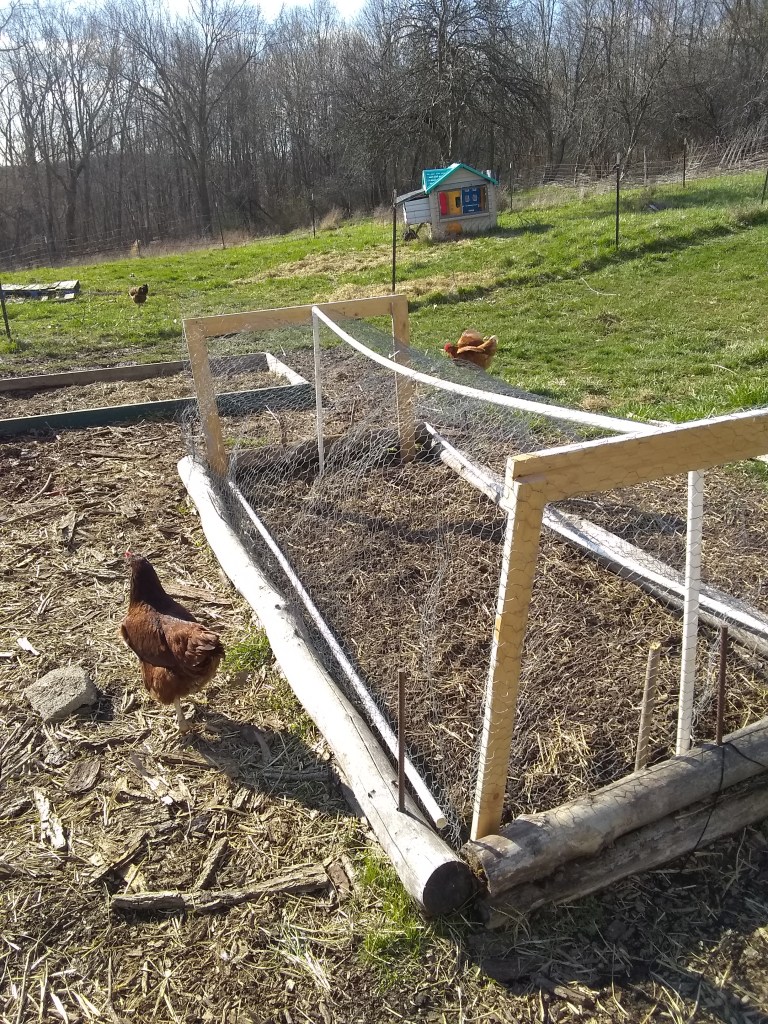
See? It’s working already!

We’ve spent years (all of them) trying different methods of chicken containment and ways of keeping them out of the garden. We tried the chicken tractor method (spoiler: you have to have really flat ground — we never have), chicken fencing around the entire garden space (ironically, chickens just jump right over chicken fence), and keeping them in a designated chicken yard. None of them seemed to be quite right for our style.

Enter my big and bright idea

Of the two of us, Kenny is the one that is more creative when it comes to making things to solve problems, but he’s been loaded down with work stress lately and we’ve been lagging in our projects progress (ie, I got tired of waiting….necessity truly is the mother of invention). Ergo, I got busy.

It occurred to me that all of our failed attempts were “bigger” methods of either keeping chickens “out” or “in,” but since we’ve switched to the raised bed style of gardening, there’s so much flexibility and creativity that can be done with just a single bed — one reason I love this style! All I really need to do was keep them out of the bed until the plants are big enough that they can’t kill them, so (duh) I realized that a small hoop row cover used to extend the season would work just fine.

However, we didn’t have any hoop material and with this Corvid-19 business going on right now we’re holding onto our money a little tighter until he’s back to work full time. I’m a big believer in being #frugal and #usingwhatyouhave, so . . . what we did have was lots of leftover pvc from our greenhouse days. Modification, here we go.

It’s three sections — the permanent end caps, and the hoop portion that can come off for planting, tending, and storage. I’m thinking it will hang from the garage when it’s not being used.

I have to admit that I’m kinda proud of how it turned out. I don’t usually “make” things, so I feel a bit like a badass when I do. Of course, this is day one of completed project. We’ll re-evaluate at the end of the season. :-/

I was also so eager to get #springplanting that I didn’t even wait till it was finished to put the early seeds of peas, spinach, arugula, and lettuce, beets, and carrots in. Naturally I had the company of several chickens trying to eat the peas as I put them down, one dog that thinks it’s fun to run at full speed directly toward me, and my garden buddy cat trying to sit on my lap while I was kneeling. I had to designate a living scarecrow to assist, and then he got fired for being distracted and was replaced with Barefoot Girl. It really is true that you can’t get good help these days ….

#Gardenhacks just might be my new interest. How about you? Any cool hacks to share?

My First Homemade Mayonnaise!

So we’ve had a serious glut of eggs around here all winter (yes, even winter — the time of reprieve??). We share with our neighbors that help lock up the coop if we’re out past dark and Barefoot Girl took 10 dozen to 4h, but still. We have about 12 dozen in the fridge right now.

I’m rather ashamed to admit that out of the 11 years that we’ve had chickens, I’ve never made mayonnaise.

I love mayonnaise.

I mean, I really love mayo. I eat it with sandwiches, fries (half and half with ketchup), in salad dressings, with potato salad . . . everything (is that the Midwestern in me? There wasn’t much mayo-eating in California). Why have I never made it? No idea.

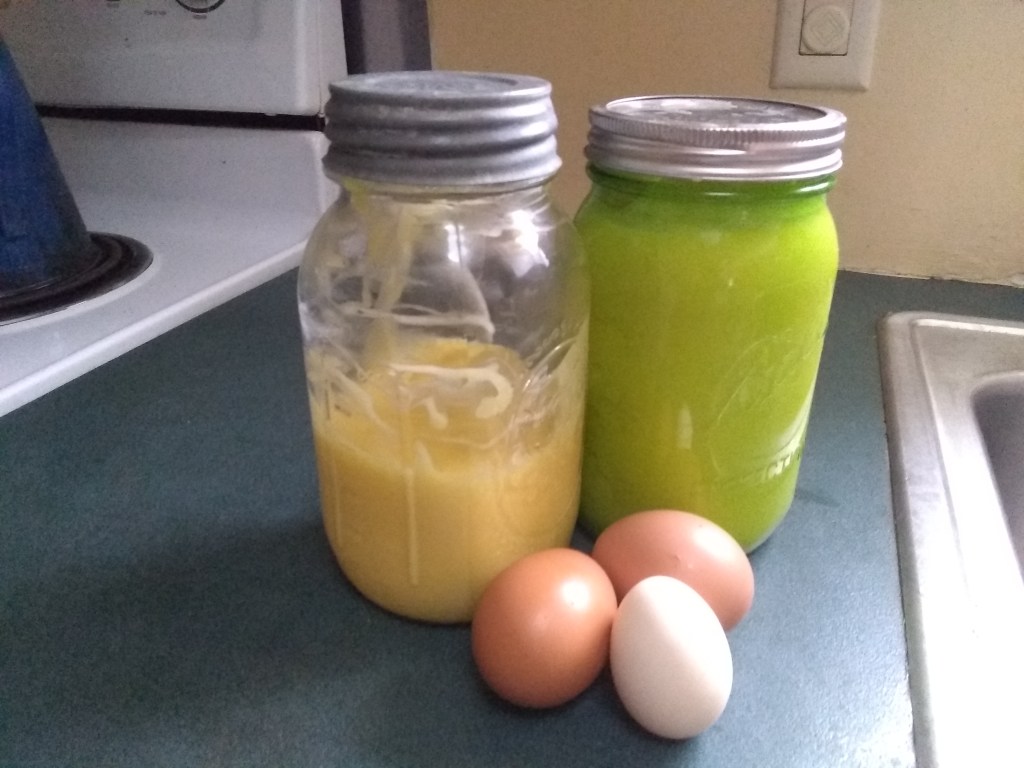
Buuuut…I’m pretty excited about this first batch. It was so simple, and definitely one of the things we should all be doing for ourselves. I messed up a bit because I forgot to add the oil slowly, so it’s a bit thinner than it should be, but it’s creamy and tasty and YELLOW! This recipe from Inspired Taste uses whole eggs, which I appreciate (I hate having to find something to do with the yolks!). Pretty excited to be adding this to our homestead repertoire.

However, major downside in the “using up the eggs” goal: I made a quart and a half of mayo and only used 4 eggs.

Eleven and a half dozen to go…

Project: Fermenting Chicken Feed

As I mentioned recently, I’ve been thinking a lot lately about chicken feed (it just occurred to me that most people would never consider this worthy of thought … interesting what our occupations lead us to ponder). Anyway, I’ve concluded that since humans have been raising chickens forever and the commercial feeds have only recently been pushed as “necessary”… leading me to believe that they’re not actually necessary for the small-scale homesteader.

Naturally, then, this article “Fermenting Chicken Feed” at Backwoods Home caught my interest. I’m well aware of the health benefits of fermented food for humans, and it turns out that it’s the same for chickens. The process utilizes just grains and a four-bucket method that Barefoot Girl explains in this video:

The author states that the benefits of fermenting their feed is that it we can use grain scraps from the feed mill instead of commercial feed, and the fermenting process makes the nutrients more available to the hens so they (theoretically) eat less. We usually go through at least one fifty-pound bag of feed a week, so we’ll keep track and see how it works!